2026年3月31日
How to Choose the Right Hairstyle
A Complete Guide to Finding Your Perfect Look Finding the perfect hairstyle starts with understanding yourself Let's be honest here: picking a new hairstyle can feel overwhelmin...

A Complete Guide to Finding Your Perfect Look
Finding the perfect hairstyle starts with understanding yourself
Let's be honest here: picking a new hairstyle can feel overwhelming. You stand in front of the mirror, scroll through endless Instagram feeds, and still walk out of the salon wondering if you made the right choice. Sound familiar? You're definitely not alone in this struggle. The truth is, finding a hairstyle that actually works for you involves more than just picking something that looks good on a celebrity or in a magazine.
The perfect hairstyle should work with your face shape, complement your natural hair texture, fit your daily routine, and make you feel confident every single day. That might sound like a tall order, but once you understand the key factors that go into this decision, choosing becomes much less of a guessing game and more of a strategic choice.
In this guide, we'll walk through everything you need to know to find a hairstyle that genuinely works for you. No more settling for cuts that looked better in your head than they do in the mirror. By the end, you'll have a clear framework for making your next salon visit a success.
Step 1: Figure Out Your Face Shape
This is the foundation of everything, and yet so many people skip right past it. Your face shape determines which styles will naturally flatter your features and which ones might work against them. The good news? Determining your face shape isn't complicated once you know what to look for.
How to Measure Your Face
Grab a flexible measuring tape and stand in front of a mirror. You'll need to take four key measurements to figure out where you land. First, measure the length of your face from the center of your hairline down to the bottom of your chin. Second, measure across your forehead at its widest point, typically right between your eyebrows and hairline. Third, measure across your cheekbones, starting and ending at the outer corners of your eyes. Finally, measure your jawline from the tip of one ear, down across your chin, and back up to the other ear.
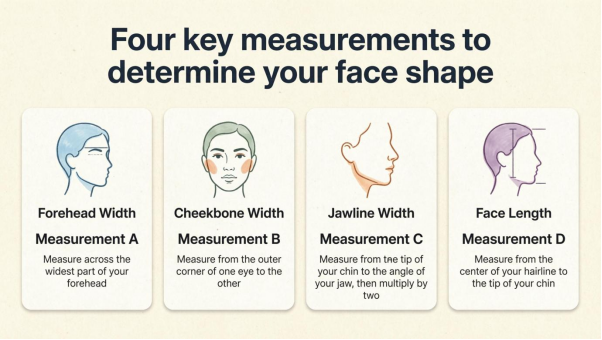
Four key measurements to determine your face shape
Write these numbers down and compare them. The relationships between these measurements will tell you exactly what shape you're working with. If you don't have a measuring tape handy, you can also try the mirror trick: pull your hair back completely, stand facing a mirror, and use a lipstick or dry-erase marker to trace the outline of your face directly on the glass.
The Five Main Face Shapes
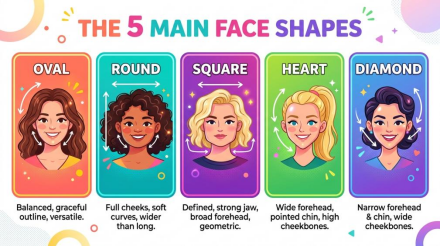
Understanding the five main face shapes
| Face Shape | Key Characteristics | Best Styles | Styles to Avoid |
|---|---|---|---|
| Oval | Face length > width; forehead slightly wider than jaw; gentle rounded jawline | Almost anything works; layered cuts, bobs, side-swept bangs | Heavy bangs that cover the balanced proportions |
| Round | Width and length roughly equal; full cheeks; rounded chin with no sharp angles | Styles that add height/length; long layers, deep side parts, volume at crown | Chin-length bobs, heavy fringe, center parts |
| Square | Forehead, cheekbones, and jawline similar width; strong, angular jaw | Soft layers, side-swept bangs, texture that softens angles | Blunt cuts, straight-across bangs, one-length styles |
| Heart | Wide forehead and cheekbones; narrow, pointed chin; often a widow's peak | Chin-length bobs, side-parted styles, layers that add width at jawline |
If your measurements don't fit perfectly into one category, don't stress about it. Most people have features from multiple face shapes, and you might be somewhere in between. The key is identifying which characteristics are most dominant and choosing styles that work with those features.
Step 2: Work With Your Hair Texture, Not Against It
Here's something a lot of people don't realize: your hair texture might be the single biggest factor in whether a hairstyle actually works for you. You can have the perfect face shape for a certain cut, but if your hair texture fights against it every morning, you're setting yourself up for frustration.
Understanding the Four Main Hair Types
Hair texture falls into four main categories, and within each category, there's a spectrum from fine to coarse. Type 1 is straight hair that has no natural curl or wave pattern. Type 2 is wavy hair that forms an "S" shape and falls somewhere between straight and curly. Type 3 is curly hair with defined curls that spring back when stretched. Type 4 is coily or kinky hair with tight curls or zigzag patterns that shrink significantly when dry.
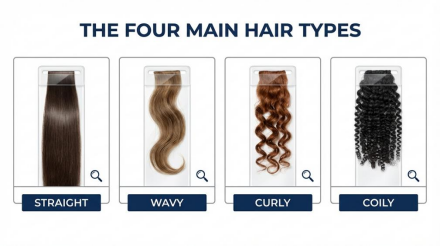
The four main hair type categories
Fine vs. Thick Hair
Separate from curl pattern, there's also the question of hair density and strand thickness. Fine hair has thin individual strands that can be easily overwhelmed by heavy products or too much layering. Thick hair has substantial strand diameter and can handle weightier cuts but might require more thinning or texturizing to avoid looking bulky. Knowing where you fall on this spectrum helps determine which cuts will give you the body and movement you're looking for.
| Hair Type | Characteristics | Best Cuts | Styling Tips |
|---|---|---|---|
| Type 1: Straight | No natural curl; reflects light well; tends to get oily faster | Blunt bobs, long one-length cuts, sleek ponytail-friendly styles | Use lightweight products; avoid heavy oils that flatten |
| Type 2: Wavy | S-shaped pattern; frizz-prone; can be straightened or enhanced | Long layers, beachy textures, curtain bangs | Scrunch while damp; use mousses over creams |
| Type 3: Curly | Defined spirals; prone to dryness; significant shrinkage when dry | Deva cuts, layered styles that distribute volume, tapered ends | Apply products to wet hair; diffuse or air-dry |
| Type 4: Coily | Tight curls/zigzag pattern; most fragile; maximum shrinkage | Shape-ups, tapered cuts, protective style-friendly lengths | Regular deep conditioning; minimal manipulation |
The biggest mistake people make is trying to force their hair into a texture it naturally resists. If you have fine, pin-straight hair and you're dreaming of voluminous beach waves, you might spend hours every morning with a curling iron only to watch the style fall flat by lunch. Work with what you have, and you'll spend less time fighting your hair and more time enjoying it.
Step 3: Be Honest About Your Lifestyle
This is the reality check that a lot of hairstyle guides gloss over, but it matters more than almost anything else. That gorgeous, elaborate updo you saw on Pinterest might be stunning, but are you actually going to spend 45 minutes every morning recreating it? Be real with yourself here.
Low-Maintenance vs. High-Maintenance Styles
Low-maintenance hairstyles are cuts that look good with minimal daily styling. Think one-length bobs, long layers that air-dry well, or short crops that require just a quick finger-comb. These work best for people who value sleep over styling time, have active lifestyles, or simply prefer a more natural look. High-maintenance styles require regular styling, frequent salon visits, or both. Picture blunt bobs that need regular trims to maintain their shape, bangs that require daily blow-drying, or color treatments that demand touch-ups every few weeks.
Questions to Ask Yourself
How much time do you realistically spend on your hair each morning? If the answer is 10 minutes or less, look for wash-and-go styles that work with your natural texture.
How often can you visit the salon? Short styles and precise cuts typically need maintenance every 4-6 weeks, while longer, layered cuts can go 8-12 weeks between appointments.
What does your daily environment look like? If you work in a conservative office, wild colors or extreme cuts might not fly. If you're constantly outdoors or at the gym, you'll want something that handles humidity and sweat.
What's your styling skill level? If you struggle to use a round brush, a cut that requires blowout skills to look good will become your enemy. Choose styles that work with the tools you actually know how to use.
Step 4: Master the Salon Consultation
Even with all your homework done, the consultation at the salon is where everything comes together or falls apart. This is your chance to communicate what you want clearly and get professional feedback on whether it'll work for you. Too many people sit down in the chair and either freeze up or speak in vague terms, then leave disappointed.

A good consultation is the key to getting the style you want
Bring Visual References
Words like "textured" and "layered" mean different things to different people. The most effective way to communicate what you want is to bring photos. Find 3-5 images of hairstyles you like, and be specific about what you're drawn to in each one. Maybe it's the bangs in one photo, the length in another, and the layers in a third. This gives your stylist concrete direction to work with. But here's the important part: be prepared for your stylist to tell you if something won't work. They're looking at your hair type, face shape, and lifestyle with a trained eye.
Questions Worth Asking
"What will this look like as it grows out?" Some cuts age gracefully; others become awkward mullets within weeks.
"What products will I need to maintain this at home?" If the list is long and expensive, that's useful information.
"How much daily styling does this cut require?" Get specifics on time and technique.
"Based on my hair type and face shape, what would you suggest?" Sometimes stylists have ideas you'd never think of yourself.
"How often will I need touch-ups?" This affects both your schedule and your budget.
Common Mistakes to Avoid
Now that we've covered what to do, let's talk about what not to do. These are the pitfalls that lead to salon regrets and awkward grow-out phases.
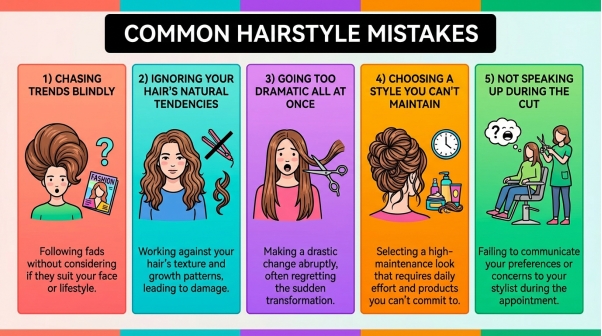
Avoid these common hairstyle mistakes
Chasing trends blindly. Just because the butterfly cut is all over TikTok doesn't mean it's right for you. Trends cycle through quickly, and what looks fresh today might feel dated in six months. Focus on styles that complement your features rather than whatever's currently viral.
Ignoring your hair's natural tendencies. If your hair has a strong cowlick, a center-parted style will constantly rebel. If your curls are naturally loose, trying to achieve tight ringlets will require daily effort that most people won't sustain. Learn your hair's personality and work with it.
Going too dramatic all at once. If you've had long hair for years and suddenly chop it all off, you might love it—or you might experience serious regret. Consider making gradual changes so you can adjust emotionally and practically to a new look.
Choosing a style you can't maintain. That precision bob looks incredible when your stylist does it, but if you don't have the skills or time to maintain it, you'll spend weeks feeling frustrated before your next appointment.
Not speaking up during the cut. If something doesn't feel right or you're not sure about a suggestion, say so. Your stylist would rather have a conversation mid-appointment than have you leave unhappy and never return.
Putting It All Together
By now, you should have a clearer picture of what goes into choosing the right hairstyle. The process isn't about finding some mythical "perfect" cut, but rather about finding the right fit for your specific combination of face shape, hair texture, lifestyle, and personal style. It's a balancing act, and everyone's equation looks a little different.
Start by getting honest about your face shape and hair type. These are your non-negotiables, the factors you can't change. Then think through your lifestyle realistically. How much time do you want to spend on your hair? What's your maintenance tolerance? Finally, work with a stylist you trust to translate all of this into a cut that makes sense.
And remember: hair grows back. Even if a cut doesn't turn out exactly as you imagined, it's temporary. Don't let the fear of a wrong choice keep you stuck in a style that doesn't make you feel confident. Use this framework to make an informed decision, and then take the leap. Your perfect hairstyle is out there waiting for you.
Quick Reference Checklist
Before your next salon appointment, run through this checklist to make sure you're fully prepared:
Know your face shape (oval, round, square, heart, or oblong)
Identify your hair type (straight, wavy, curly, or coily) and texture (fine vs. thick)
Determine your maintenance level (low, medium, or high)
Gather 3-5 reference photos showing specific elements you like
Prepare questions for your stylist about maintenance and grow-out
Be open to professional feedback on what will actually work for your hair